


On November 12, Jensen Huang resigned as CEO of Nvidia, the company he co-founded and ran for 33 years (!!). He left the board the same day.
Four days earlier, the board had opened an investigation after The New York Times reported on his relationship with a Chinese citizen whom the U.S. government believes may be working for Beijing.
Much ink is being spilled on the whole saga. I will not regurgitate anything here.
The two questions I want to explore are:
1. Many people have argued that founder-controlled companies outperform. But how much control is optimal and when is it too much?
2. Ok, so the company is founder-controlled. How should a company think about generational transition?
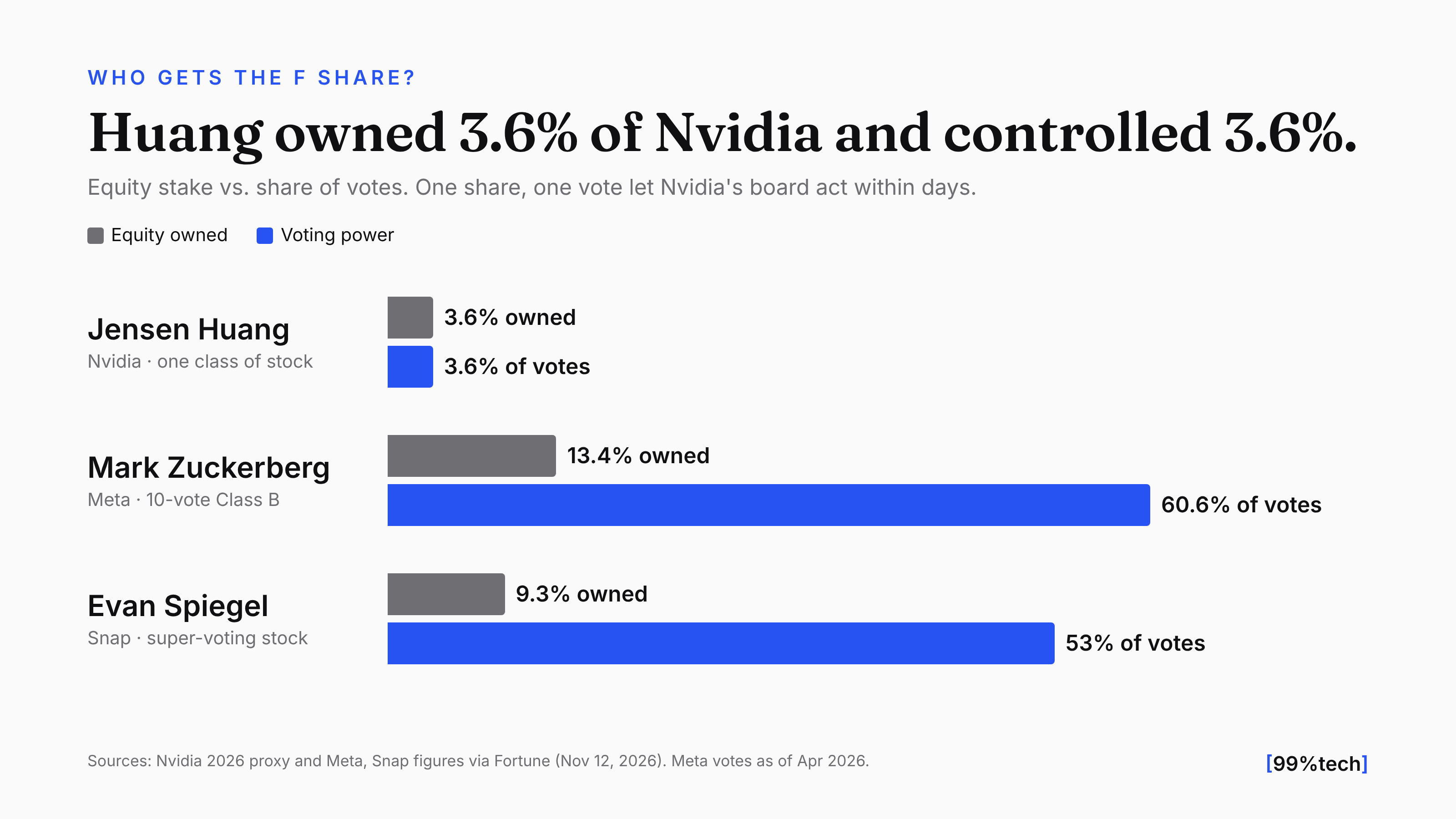
For context, Huang was a prototypical “Founder CEO”. While he only owned about 3.6% of a company worth nearly $4 trillion he was the face and living embodiment of the company. But from a control standpoint, Nvidia has one class of stock: one share, one vote – so he did not have control. Conversely, Founders Mark Zuckerberg, who has utilized “F” (super voting “Founder” shares) shares, retain over 60% of votes on only 13.4% of its equity. It would be much harder to push him out.
The second issue is continuity. As a Founder-led firm, Huang managed more than 50 direct reports and after 33 years, with no identified successor, Nvidia’s plan for life after Jensen is its CFO in an interim role. The stock fell as much as 14% on the day.
So what is the lesson founders should glean from this story? That Huang needed an F share? Or that Nvidia’s board never properly thought about succession? These are often opposite questions. Companies that keep founder control by design are less likely to think about succession.
So this sent me down a rabbit hole.
In this piece, I hope to cover three things.
Recap about the current founder control structures today
A bit of a history on how continuity and control has been achieved successfully elsewhere
Exploration on how things are changing in the world of AI
The obsession with founder control
In San Francisco, the standard setup is common stock for founders and preferred stock for VCs. VCs will balk at a deal where the founders have insufficient stock ownership (looking at you studios that take 40-60% at founding).
Back in 2009, the Founder Institute pitched the aforementioned “Class F” stock instead: ten votes per share, double board votes, approval rights over new rounds. Google, Facebook and Snap took versions of it public. In 2025, 15 of 31 US tech IPOs carried more than one share class, according to Jay Ritter’s data.
Founder led companies are good for shareholders, at least for a while. Bain found that founder-led companies in the S&P 500 delivered total shareholder returns 3.1 times those of other companies in 2014, and outperformed throughout 1990 to 2014. The explanation is old. In 1976, Michael Jensen and William Meckling described the principal-agent problem: hired managers spend other people’s money, and owners spend their own. A founder with a big stake thinks like an owner.
The F Share may not be required as Nvidia has shown. Huang built one of the most valuable companies on earth with a single-digit stake and one vote per share. Martijn Cremers, Beni Lauterbach and Anete Pajuste studied every US IPO from 1980 to 2015. Dual-class firms started out trading about 11% above comparable single-class firms. Six to nine years later, the premium had turned slightly negative, while the gap between the controller’s votes and economic stake widened from 16% to 26%.
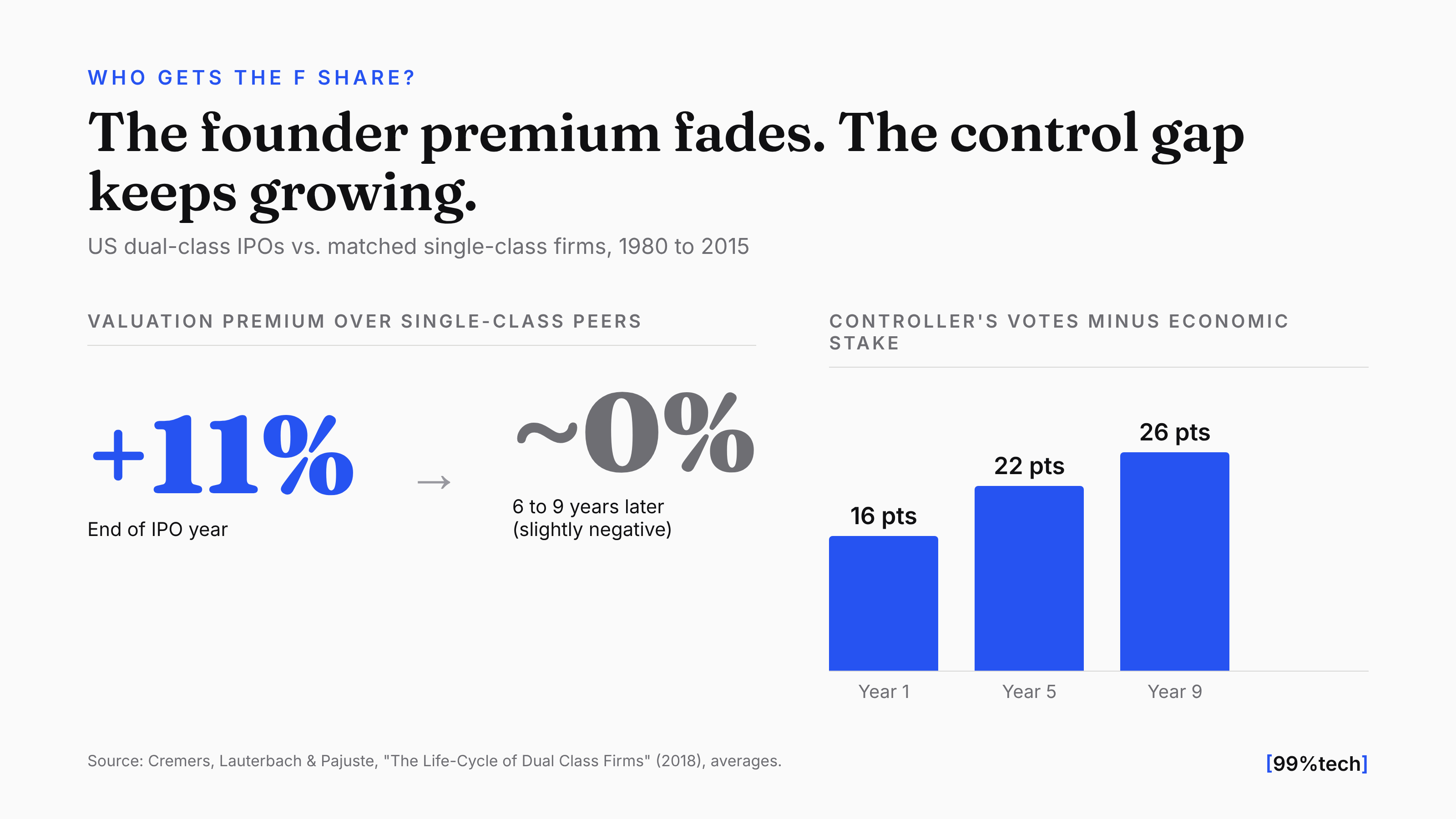
My read: the dual-class premium is mostly a founder control proxy. The F share captures the owner mindset early, while the founder still holds a big stake. Then the founder sells, gives away stock or gets distracted. The votes stay, and the owner slowly becomes an agent with a veto.
By the way, we only hear the survivor stories.
Zuckerberg and Page get cited; WeWork rarely does. Adam Neumann held shares carrying 20 votes each. In September 2019, WeWork’s target IPO valuation fell from $47 billion to about $15 billion, Neumann stepped down and the IPO was pulled. And would Facebook have turned out differently without its F share? Less than people assume. Zuckerberg turned down Yahoo’s $1 billion offer in 2006, three years before Facebook created its two-class structure. His stake did that work.
My view: F shares are one tool for aligning founder and company interests. Not the only one and not necessary.
Ok, so we covered question 1. Let’s dive into succession and where things have gone well elsewhere.
Succession and its discontents
Business and government succession is litered with failures. I think some of the traditional modes are pretty clear.
1. Pass it to the eldest. Method for royalty. But works until you have a dud. And is obviously unfair. And tough if there is no heir, or the heir is to young, etc.
2. Ignore it. Nobody sets a rule, so the heirs fight.
3. Split it equally. Everyone gets a vote. The result is dilution of interest and capital interest.
By the way, one of my favorite examples is Genghis Khan. He built the largest contiguous land empire in history. He did avoid #1 by passing the throne to one of his more capable sons. But according to the anthropologist Jack Weatherford, his daughters were his best administrators: each ruled her husband’s nation while the husband served in the army, and Alaqai Beki ran the Ongud on the border with Jin China until 1230. It was supposed to be passed on, but no clear guidelines were set. The sons inherited the empire instead and fought over it. The grandsons fought a civil war from 1260 to 1264, and the empire split into four khanates.
Rupert Murdoch is perhaps one of the best modern cautionary tales. His family trust gave his four eldest children equal votes after his death and named no successor. When he tried to amend it in Lachlan’s favor, and went to probate court, the family settled in September 2025: Lachlan’s three siblings received about $3.3 billion in total, and he controls a new trust until 2050. Super-voting stock served one man for decades and broke at the handoff.
Ok, so what does work? Here are a few interesting (though not necesarrily applicable solutions in the modern age) whose insights are relevant.
Adopt the talent
H/T to Sheel Mohnot, whose tweet drove me down this rabbit hole.

Japan has more old companies than any other country: 46,708 businesses over 100 years old at the end of 2025, according to Teikoku Databank, and 11 over 1,000.
One strategy that solves the 3 failure modes helps explain it. In 2000, 98% of Japanese adoptions were adults. Many were mukoyōshi: a capable man marries a daughter of the family, takes its name and runs the business. Suzuki Motor has been run by four adopted heirs, including Osamu Suzuki, born Osamu Matsuda. Nintendo and Panasonic each had an adopted son-in-law as second president.
Economists Vikas Mehrotra, Randall Morck, Jungwook Shim and Yupana Wiwattanakantang found that firms run by adopted heirs outperformed firms run by blood heirs, and that Japanese blood heirs beat professional managers too. The threat works both ways: a son who knows the family can adopt a better candidate has every reason to earn the job.
Combine this with structured written rules
In 1810, Mayer Amschel Rothschild signed a partnership agreement with his sons. He kept the casting vote. Heirs of a dead partner could not demand to see the books, on penalty of 20,000 thalers, and were paid in firm assets rather than cash. Control stayed with the people doing the work.
It was also sexist and unfair. His will left the business to his sons alone; his daughters and their husbands could own none of it. But it kept the bank private, in trusted hands and became at one point the largest private enterprise.
Sweden’s Wallenbergs run the modern, fairer version. Sixteen family foundations hold 23% of Investor AB’s capital and just over half its votes. The selection is the clever part. Of about 30 sixth-generation members, each chooses whether to join; those who opt in rotate through sessions with the current leaders every six weeks, and in 2025 six entered the inner circle, women among them for the first time. The family learned the cost of the old way: Marc Wallenberg, groomed from birth as heir apparent, died by suicide in 1971 under that pressure.
Make control impossible to own
Venice went the other way. From 1268, the Republic elected its doge through ten alternating rounds of lottery and vote, a process too random for any family to rig. The Republic lasted another five centuries, until 1797.
Patagonia offers the founder-exit version. In 2022, Yvon Chouinard moved all of the company’s voting stock, 2% of the shares, into a purpose trust overseen by family and close advisors. The other 98%, all nonvoting, went to a nonprofit that is projected to receive roughly $100 million a year in profits. Patagonia was already a certified B Corp. That label never decided who controlled the company. The trust did.
The new experiments
What’s interseting is that new experiments - destined to become HBS case studies one day, either of success or failure - are being crafted today within AI labs. Most notably:
OpenAI gave its nonprofit board the functional equivalent of an F share. In November 2023 the board used it and fired Sam Altman. Within days, nearly all of the company’s roughly 770 employees threatened to follow him to Microsoft, and he was back inside a week. Its 2025 recapitalization left the OpenAI Foundation with 26% and the right to appoint the board.
Anthropic filed to go public with the opposite design: a single Class F share, held by an LLC of its seven co-founders, carrying no economic rights and 50.1% of the vote. Once fewer than three of the founders remain, the share begins to phase out. A separate Long-Term Benefit Trust elects a majority of the board with no expiry date. Whether it works is a question for 2040, but the succession rule ships with the control right.
What I would tell a founder
Ok, so what is the conclusion of this deep dive. First, don’t have an affair. Second, keep solid governance. Ok obvious.
And, on the topic of Founder control and continuity. Yes to both.
Founder control is a good idea. As an investor, that is who I’m backing. Everything else is necessary but not sufficient. So I want the founder in the seat, engaged, and with a sense of ownership. F shares can be part of that for certain companies, but generally I am biased against it.
Either way, we still need governance and as the company matures from a startup into a real company with real revenues, firm building that creates the possiblity of continuity.
There are many tools, and many to get reinvented, but the basics remain true.
What do you think?