![[99%tech]](https://substackcdn.com/image/fetch/$s_!vl72!,w_120,h_120,c_fill,f_webp,q_auto:good,fl_progressive:steep/https%3A%2F%2Fsubstack-post-media.s3.amazonaws.com%2Fpublic%2Fimages%2Fcae24093-688e-4321-a6fa-ee9385f8979c_1024x1024.png)
![[99%tech]](https://substackcdn.com/image/fetch/$s_!Sljl!,e_trim:10:white/e_trim:10:transparent/h_72,c_limit,f_auto,q_auto:good,fl_progressive:steep/https%3A%2F%2Fsubstack-post-media.s3.amazonaws.com%2Fpublic%2Fimages%2F02f85460-45dd-47b2-a64c-f9e2bf0372af_1500x1000.png)

The Big Four were all founded around 1850. Deloitte in 1845. Price Waterhouse in 1849. The industrial revolution had created companies too large and too complex for any single owner to verify directly. The model that emerged was simple. Send humans to check the books. Sample a fraction of transactions. Issue an annual opinion.
For 150 years that model survived almost untouched. Physical ledgers became spreadsheets. Spreadsheets became databases. Databases became real-time APIs. Humans kept modifying records, and other humans kept retracing their steps.
That era is over. The financial system is no longer a ledger. It’s a machine.
The era of humans checking the work of other humans in finance is ending.
Today the Big Four collect more than $300 billion in combined revenue for delivering a service built for a world that no longer exists. Sampling made sense in 1850, when checking every transaction was impossible. In 2026, a machine can examine every record, every transaction, multiple times a year. Sampling is now indefensible. You need a machine to check the machine.
The verification gap
AI is dramatically lowering the cost of producing things. Documents. Code. Decisions. Transactions. The cost of verifying that output is not dropping at the same rate.
You see this most clearly in legal tech today. Anyone can generate a contract in seconds, but a human still has to review it, and the review is now the bottleneck. The same dynamic is unfolding across every knowledge industry.
Finance is one of the biggest, fastest-growing, and highest-stakes nodes of this. AI is writing journal entries, configuring accounting systems, generating invoices, producing reports. The systems doing the work are accelerating. The systems checking the work are not.
Verification is becoming an AI-era category. It is the inverse of generation. Both are scaling. Right now only one of them has the infrastructure.
Business model inspiration and where this problem has already been solved
The pattern is consistent: verification work and the warranty that comes with it rebundle into a single product, usually delivered by software, replacing what used to be a fragmented manual process.
Before title insurance existed, anyone buying a property had to commission a separate legal review of the chain of title, hope it was complete, and bear the risk of error themselves. Title companies rebundled the verification and the warranty into a single product. Software ate most of the manual work over the past decade, and the product is still the most trusted layer in every US real estate transaction.
Vanta is a more recent precedent and a closer analogy. SOC 2 compliance used to require expensive consultants documenting controls and an annual auditor checking sample evidence. Vanta turned the verification into continuous software monitoring and bundled the attestation on top. The work is the platform, the attestation is the byproduct and the distribution is embedded. The market reorganized around it in five years.
We believe audit is the next category to follow this arc.
Introducing Oath
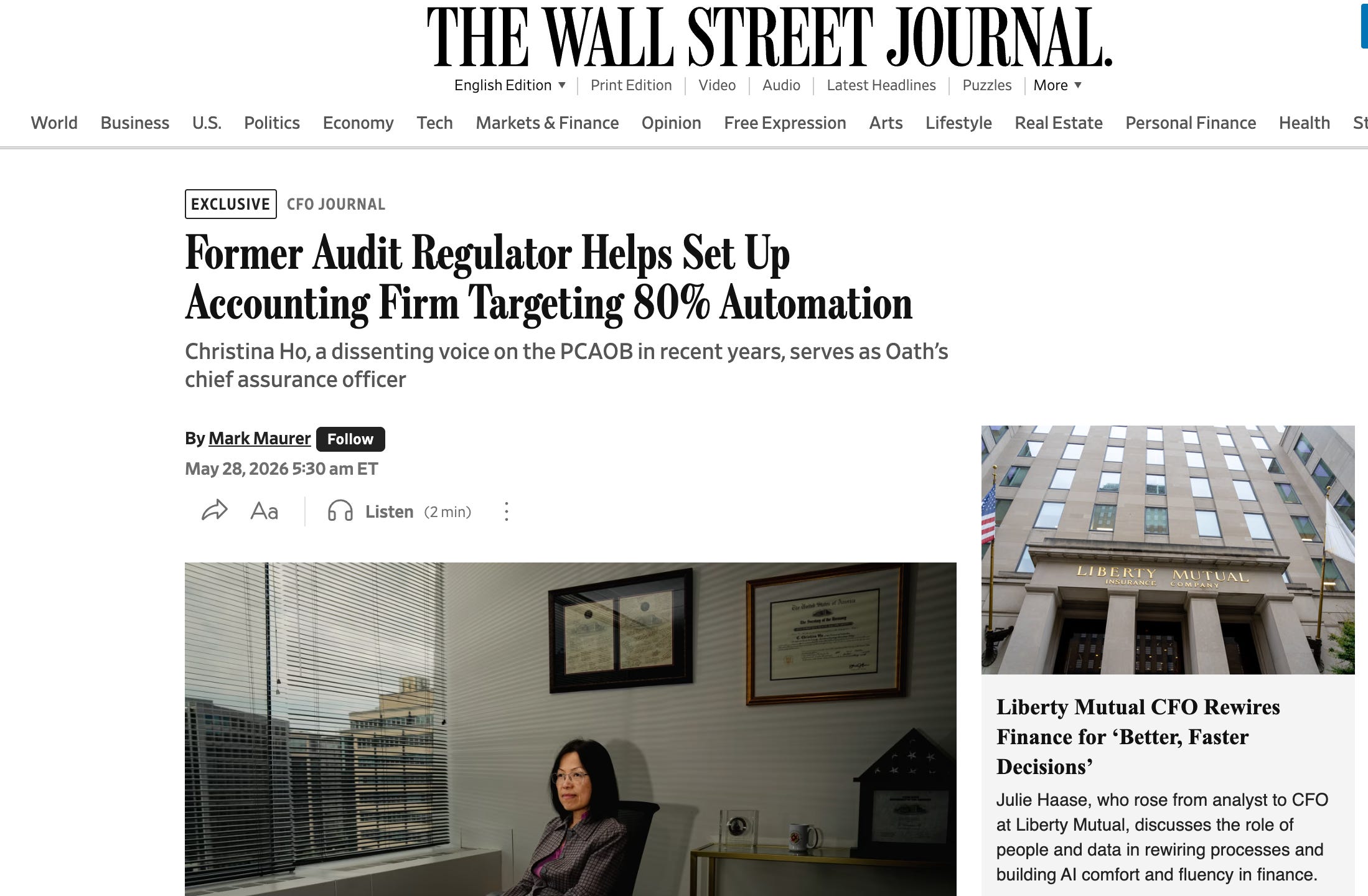
Oath is a financial verification platform, which we just unveiled in the Wall Street Journal this week.
A full financial audit is a defined set of procedures: checks on transactions, balances, documents, calculations, and controls. Historically bundled, performed annually, delivered as a single opinion. Oath delivers those same procedures as software. Comprehensive, not sampled. In sync with the close, not the annual opinion. Every record, not a subset.
Oath has had to build a complicated regulatory structure, including a captive audit company (not a simple software business), insurance provision and data security.
Audit-AI is not a category where you can hire credibility into the founding team. You need it on day one. Building the next version of audit takes three things at once: deep technology, real operating experience in regulated finance, and credibility inside the audit profession itself. Most teams have one. Some have two. This team has all three.
Lucas Ward, CEO. Serial entrepreneur and most recently co-founder of Kin Insurance, where as CTO he scaled the company from idea to a fully licensed home insurance carrier ($2 billion valuation, profitable since 2023, more than $600 million in inforce premiums, over $100 billion of insured property, licensed in 13 states). A decade building regulated financial infrastructure that has to ship and operate inside hard regulatory boundaries. Also Fluent’s Venture Partner.
Chris Pesigan, COO. Built Players Health as COO and VP of Insurance. Started his career at EY Financial Services audit. Knows both sides of the audit table.
Christophe Frerebeau, CPO. Founded Fundspire (with Lucas), sold to eVestment, ultimately Nasdaq. Founded Della AI, an LLM legal review platform, sold to Wolters Kluwer.
Christina Ho, Head of Audit. Former Board Member at the Public Company Accounting Oversight Board from November 2021 to January 2026, the regulator that oversees every audit firm in the US public market. At the PCAOB she chaired the Technology Innovation Alliance Working Group, producing the regulatory blueprint for AI in audit. We are building exactly what that blueprint described. Before the PCAOB she was Deputy Assistant Secretary at the US Treasury, overseeing federal financial reporting on more than $3 trillion in assets. She began her career at Deloitte. CPA, Certified Information System Auditor.
Why this isn’t a Claude project
Most applied-AI companies have the same problem. They sit between two parties and shuffle data. Either side can eventually get good enough at AI to do the work themselves. The middle gets squeezed.
At Fluent, we believe the companies that win own one of the endpoints, not the middle. Oath owns one of the endpoints.
A call to builders
Fluent didn’t just invest in Oath. We incubated it. Lucas joined Fluent as an LP and Venture Partner after Kin (where Alex had co-led the seed round at a previous firm). Alex, Lucas, and Chris had been brainstorming companies together.
Fluent is a global fund. We back proven models adapted for new markets, and we back models that travel before they’re proven. Oath is our second incubation in the AI services category (and second with a unicorn founder).
To the builders reading this: if you are building a vertical AI agent that replaces a partnership-bound professional services category, in any geography, we want to talk. Legal has Crosby. Audit has Oath. Healthcare, tax, regulatory compliance, asset management operations: every one of these categories has the same structural opportunity.
We would like to incubate 1-2 more companies in this category, and will invest in 3-4 more. Please reach out.