![[99%tech]](https://substackcdn.com/image/fetch/$s_!vl72!,w_120,h_120,c_fill,f_webp,q_auto:good,fl_progressive:steep/https%3A%2F%2Fsubstack-post-media.s3.amazonaws.com%2Fpublic%2Fimages%2Fcae24093-688e-4321-a6fa-ee9385f8979c_1024x1024.png)
![[99%tech]](https://substackcdn.com/image/fetch/$s_!Sljl!,e_trim:10:white/e_trim:10:transparent/h_72,c_limit,f_auto,q_auto:good,fl_progressive:steep/https%3A%2F%2Fsubstack-post-media.s3.amazonaws.com%2Fpublic%2Fimages%2F02f85460-45dd-47b2-a64c-f9e2bf0372af_1500x1000.png)

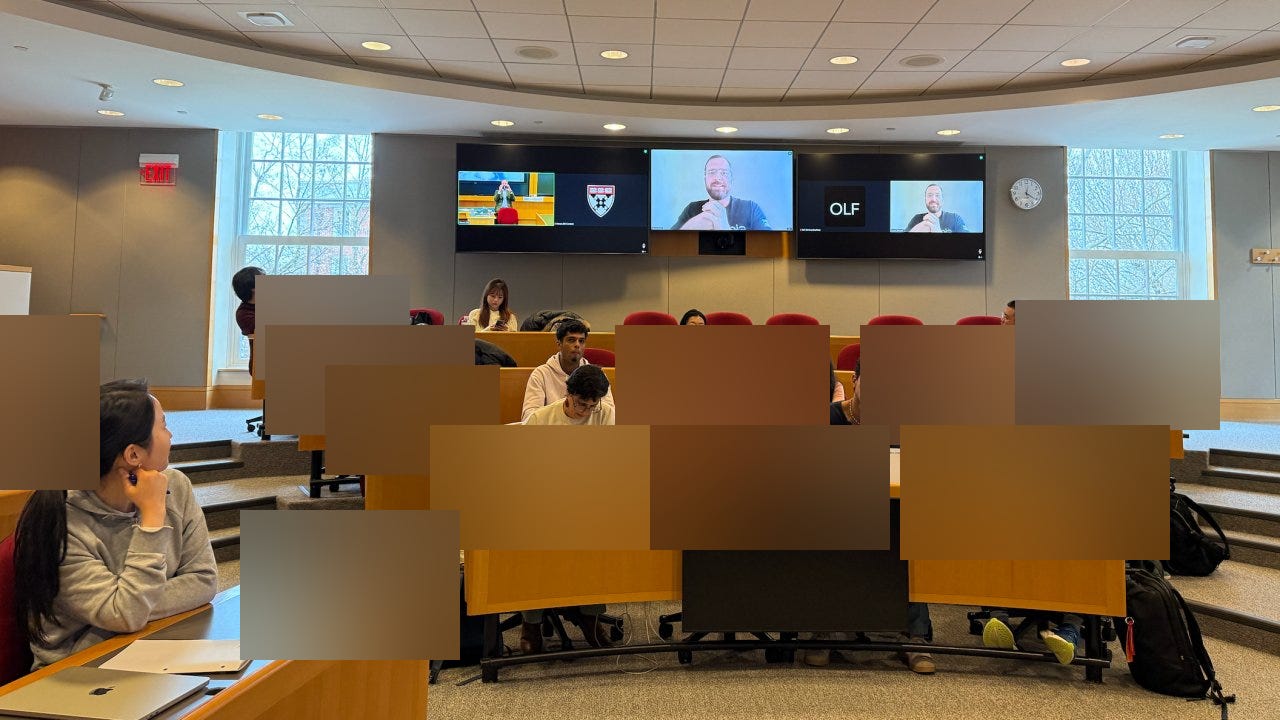
Last week I guest lectured at Harvard Business School. The class was DJ DiDonna’s Global Venturing course. Lucas Giorgio, co-founder of Avenia (the stablecoin infrastructure company we backed at Fluent Ventures), joined as the guest speaker.
The session was supposed to be about geographic arbitrage, camels, and stablecoins. We covered all of that. But the questions students asked afterward were more interesting than anything I had prepared. They revealed the anxieties and assumptions of the next generation of builders.
Three themes kept surfacing.
1. When should I start a company?
There is a Stromae lyric I love: “Tu sais, la vie, c’est des enfants. Mais comme toujours, c’est pas l’bon moment.” Life is like kids, it’s never the right time.
That is also the truth about entrepreneurship. But it comes with a nuance that matters.
Lucas told the class he always wanted to be an entrepreneur but never had the idea. He and his co-founders ran a crypto hedge fund together. Through managing that fund, they experienced the pain of cross-border payment infrastructure firsthand. They saw how broken the rails were. They understood exactly what a stablecoin settlement layer needed to look like in Brazil. The idea did not come from a brainstorming session. It came from years of expertise inside the problem.
In Out-Innovate, I describe the best founders as cross-pollinators: people who bridge experience across industries, geographies, and domains to see solutions others miss. They accumulate expertise until the solution becomes obvious. If you are asking “what should I start?”, you probably need more time inside a problem space, not more ideation workshops.
This is especially true in regulated industries. Several students recoiled at the idea of building in fintech or healthcare. Regulation seemed like a tax on speed. I reframed it: in regulated categories, the time you spend learning compliance, building relationships with regulators, and understanding the system is not a detour from entrepreneurship. It IS the competitive advantage.
Think about it as regulatory debt, the cousin of technical debt. If you skip compliance upfront, yes, you move faster. But eventually it catches up, and the cost of retrofitting compliance into a scaled product is 10x the cost of building it in from the start. Lucas said it explicitly: “At Avenia we took a regulatory forward approach from the beginning. It may have slowed us down and likely lost some clients early on, but positioned us to reap what we sowed as we scaled with much larger clients.”
Avenia embedded regulatory engagement from day one. They joined a legal accelerator at Pinheiro Neto, one of Brazil’s top law firms, in their pre-operational phase. When Brazil’s Central Bank raised the minimum capital requirement for virtual asset providers by 8x, that was not a threat to Avenia. It was a moat. Most competitors could not meet the new requirements. Avenia could.
The biggest companies in the biggest industries, financial services, healthcare, energy, are all regulated. Domain experience in those sectors is not time wasted before starting a company. It is the prerequisite for building one that lasts.
But also: do not wait for perfect conditions. Lucas and his co-founders returned investor capital from the hedge fund and started Avenia in 2022, right as crypto was crashing. They built during the trough, hired when talent was available, and emerged right into Brazil’s regulatory window. In retrospect, it was the best possible moment. But it did not feel like it at the time.
If you are asking “what should I start?”, get deeper into a problem. If you are asking “is now the right time?”, the answer is always the same. It is never the right time. Start anyway.
2. How do I get funded?
The old playbook was: write a pitch deck, get warm intros, and do the Sand Hill Road roadshow. That playbook is increasingly obsolete.
My advice to the class was blunt. Stop pitching and start building. With AI, the cost of testing ideas has collapsed to near zero. You can build a functional product, put it in front of customers, and generate real revenue before you ever talk to an investor. VCs do not just like seeing traction anymore. They expect it. A deck and a TAM slide are not enough. What impresses investors now is a founder who shows up with a working product, paying customers, and evidence of operational discipline (even if still early, imperfect and ladden with technical debt).
Avenia was profitable before they raised a cent of venture capital. When the Series A came, it was a strategic choice, not a survival round. That is the strongest possible negotiating position.
And when you are ready to fundraise, understand that not all introductions are created equal. The single best intro to a VC comes from a founder who has made that VC money. It carries more signal than almost anything else. Two things happen at once: the deal quality must be high enough for a founder to stake their reputation on it, and the access feels proprietary to the investor. Compare that to an intro from a co-investor, which is helpful but carries different weight. The VC is thinking: how many other funds got this same intro?
Fundraising has a social dynamics layer that nobody teaches in business school. Understanding who carries the most credibility with your target investor is part of playing the game well.
3. Is every company an AI company now?
A student asked whether we invest in “AI companies.” The honest answer: for most companies, that is the wrong question.
Nobody introduces themselves as a “cloud company” today. Nobody says they are an “internet company.” Those became horizontal platforms that every business uses. For companies not providing core infrastructure in AI, I believe the world is going the same direction. It is not a category to invest in, but rather it is infrastructure that every company will build on. And if you’re not building with this infrastructure, you are building for the past.
Lucas put the progression in stark terms. “Itau built a $50 billion business with 100,000 people. Nubank built a $50 billion business with 10,000. The next company to reach that scale will do it with fewer than 1,000 or less”.
What AI changes most is how companies get built. This is what I have been calling the seed-strapping camel: raise a small seed round, use AI to build fast and lean, prove the model with real revenue, and then raise growth capital from a position of strength. If you need it at all.
At Fluent, we have not changed our thesis. We still invest in proven business models adapted for new markets. But the companies we back are building faster, operating leaner, and reaching profitability sooner than was possible even two years ago. The camel model and the AI platform shift are deeply complementary. AI is what makes the seed-strapping camel possible. The cost of building has dropped. The bar for what founders should accomplish before raising has risen. Both trends favor disciplined builders over well-funded pitchers.
There is never a good moment
The students at HBS are smart, ambitious, and globally minded. But many of them are waiting. Waiting for the right idea. Waiting for the right co-founder. Waiting for the market to be ready.
Lucas did not wait. He and his co-founders shut down a hedge fund during a crypto crash to build infrastructure nobody was asking for yet. They engaged with regulators before they had a product. They were profitable before they raised capital. They built a camel in an ecosystem that rewards unicorns.
Il n’y a jamais le bon moment. Start anyway.
For founders who have started companies: was there a specific moment when the idea crystallized from experience? Or did you take the leap before it was fully formed?
Thanks to DJ DiDonna for having me in his class, and to Lucas Giorgio for being an exceptional guest speaker. If you are building stablecoin or payment infrastructure in a new market, I would love to hear from you.