


Happy Thanksgiving!
When I started investing in venture in 2013, only four cities had ever created a unicorn. Today the number is over 300. Venture went global. It is also changing rapidly.
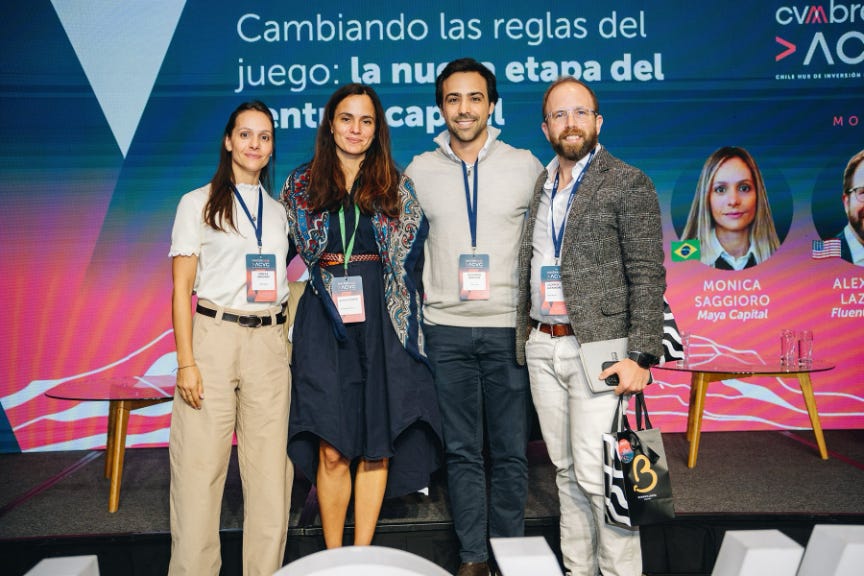
Last week I moderated a panel at the IV Cumbre ACVC in Santiago called “Changing the Rules of the Game: The New Era of Venture Capital.” On stage with me were three people who walked away from established seats to build something new: Monica Saggioro, co-founder of MAYA Capital, a well-known LatAM seed fund; Alexandre Noschese, co-founder of Across Capital, a growth fund spun out of Paul Allen’s Vulcan Capital; and Alfia Ilicheva, founder of Formulary, an AI-native fund administrator.
As I reflect over Thanksgiving weekend, here are the five shifts I see.
1. The barbell is bending
The standard story says venture is splitting into a barbell: a handful of mega-platforms on one end, a few boutiques on the other, and a squeezed middle.
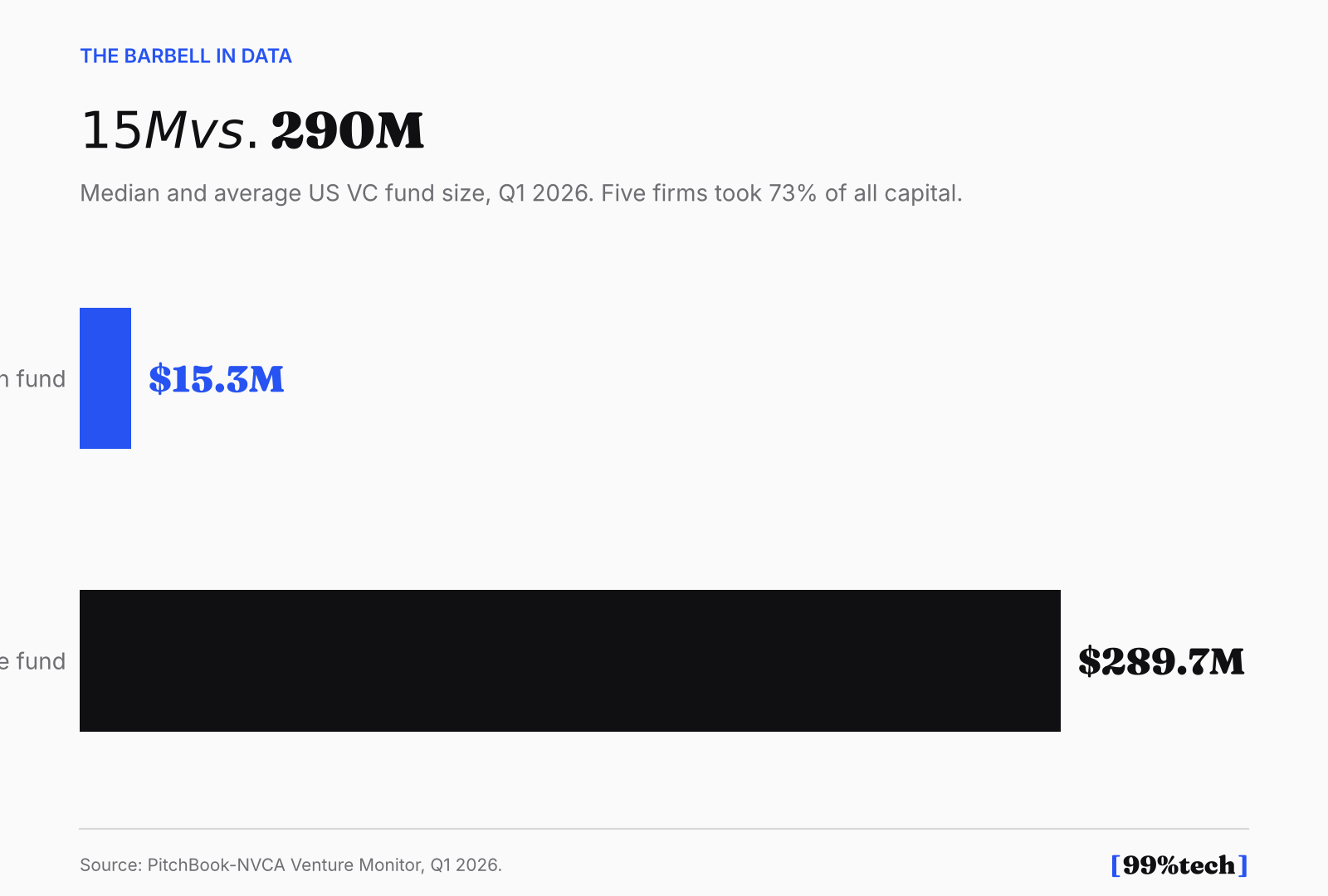
The squeeze is already visible in the data. In the US, where the numbers are clearest, the median venture fund raised in the first quarter of 2026 was $15.3 million. The average was $289.7 million. Five firms took 73% of all the capital committed that quarter.
The middle is thinning out at the same time. The number of US funds closing a raise fell from 1,793 in 2022 to 626 in 2025, first-time funds fell 78%, and capital raised dropped from $224 billion to $67 billion, the lowest since 2018.
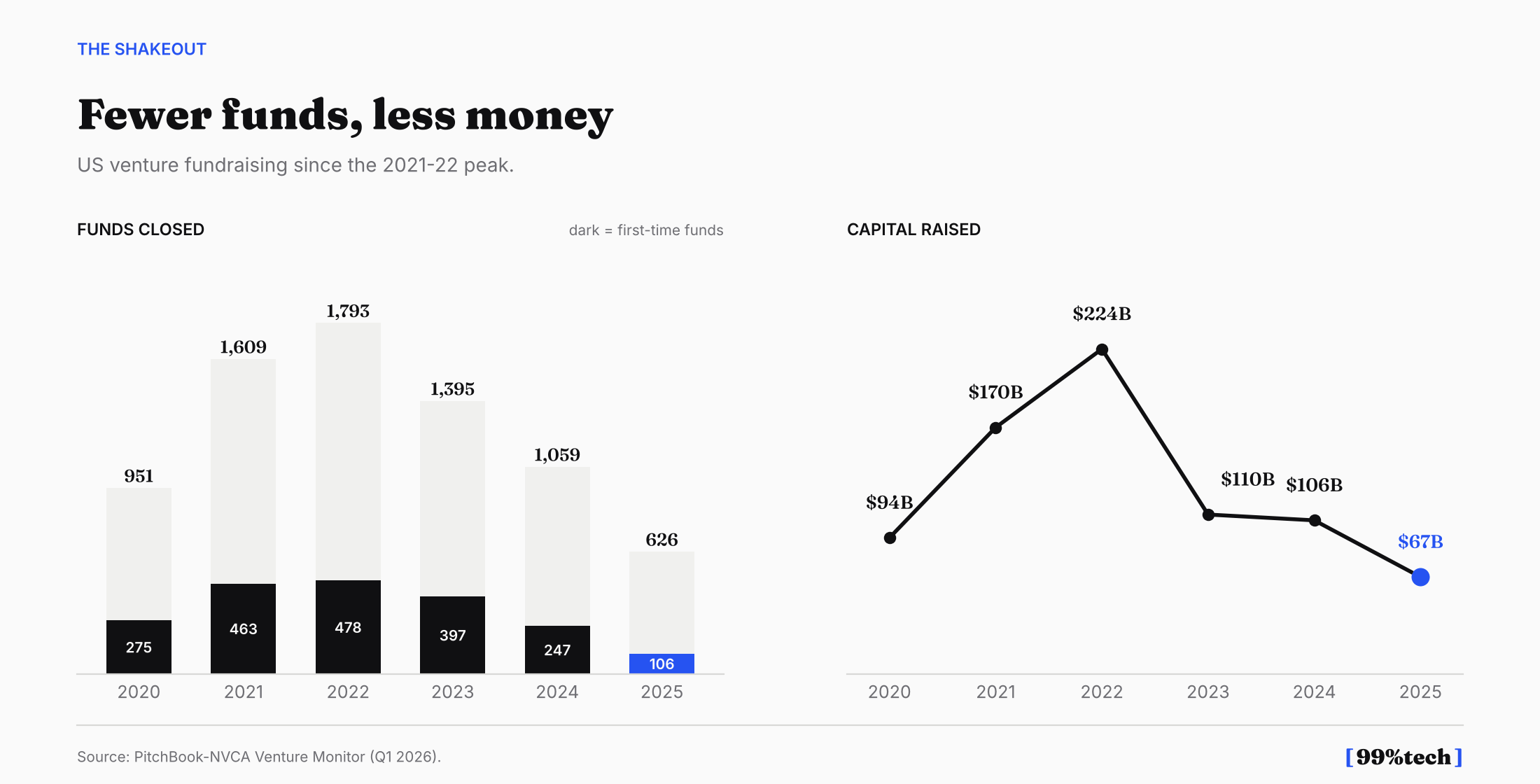
Fewer funds, less money
So I agree with the squeeze. I disagree that the specialist end stays thin. It is getting crowded, and specialization comes in more flavors than most people assume.
Geography. Across built a cross-border firm spanning the US and Latin America. “For sure there will be space for Latin-only growth equity firms,” Alexandre told the room.
Stage and approach. MAYA runs concentrated, hands-on seed portfolios.
Sector. Funds that know one industry better than anyone else in the room.
Business model. At Fluent, we specialize in models that have already worked somewhere else, backing local founders who adapt them to new markets. I call it repeat alpha.
Monica expects the map to widen further: “In five years from now you will see more global funds.”
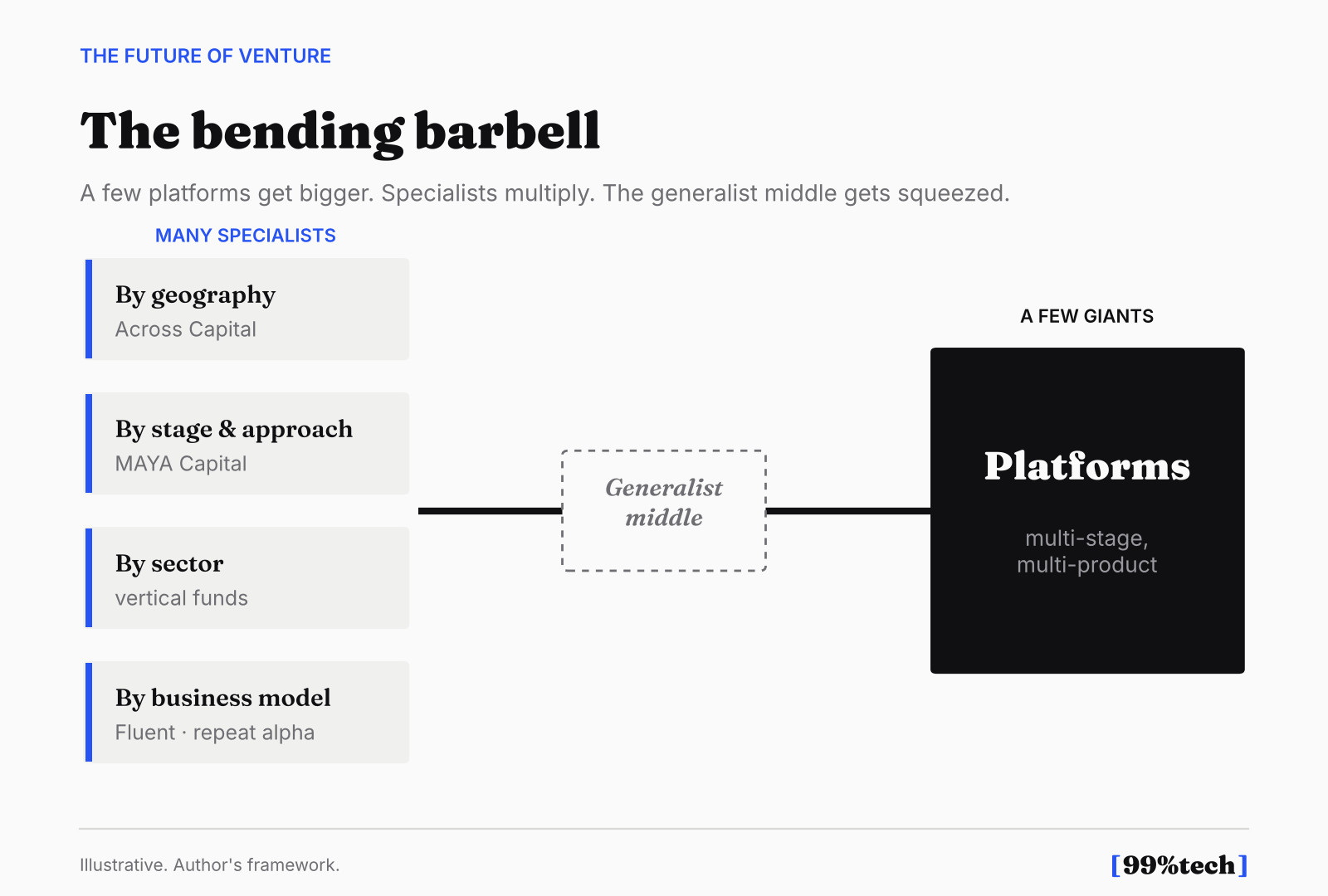
The panel consensus was that the fund in trouble sits in the middle: mid-sized, generalist, with no edge on geography, sector or model. Platforms win on scale and product breadth. Specialists win on insight and access. The middle wins on neither.
2. The practice of venture is being rewritten
AI is changing how investors actually do the job, and the panel brought receipts.
Alexandre described what happened to diligence at Across: “Before, it took us two to three days to digest a full data room. Now it takes us 30, 40 minutes.”
Monica’s team went further. “We built a company brain” she said. “We chose our LLM and we connected it to all the systems that we use at MAYA: Slack, mail, Drive, our CRM, everything, so that we can have the context, have the memory.” The payoff: “Now we can access all this historic data.” A fund’s accumulated pattern recognition, which used to live in partners’ heads, becomes searchable.
Alfia, who sees inside many funds’ back offices, cautioned that most firms are earlier than they think. She sees three stages: “1) phase 1: experiments and pilots, 2) phase 2: workflow automation and 3) AI-native operating platform powered by data.” Most funds are still in the first.
The panel also pushed back on the hype. “AI should be used for each of us to ask the smarter questions, not necessarily to jump into conclusions very quickly,” Alexandre said. He named the risk directly: “If everyone is using the same tools, maybe we’ll converge into [the same] conclusions.” Monica’s rule: “You need to challenge the AI. You need to cross-check different elements and challenge one and see what the other says.”
My view: in San Francisco, much of this already feels like table stakes. Meeting notes, end-of-day wraps and LP reporting run on AI everywhere. The bigger shift is what data does to geography. For most of venture’s history, proximity was the filter. If you weren’t in the right room in Palo Alto, you didn’t get evaluated. When a founder in Santiago, São Paulo or Lagos can be judged on the same evidence as a founder in San Francisco, the geography discount shrinks. That levels the field for founders and opens it for investors willing to look.
Then comes the paradox. Alfia put it best: “In the age of AI, building software is cheap, and earning trust is more expensive.”
I told the panel: “Every time I close a deal with a founder or an LP, I write the same words: thank you for the trust.”
On stage I asked Monica about borrowing credibility and paying it back over time. Her answer: “When we started, we were a blank page. I mean, we were a promise. We didn’t have any track record in this space specifically.” So MAYA gathered 11 advisors, “people that we had known from our network before, professors from business school, successful entrepreneurs in Brazil,” and borrowed their credibility until it could earn its own.
AI will not shortcut that process. If anything, it raises the stakes. Alfia drew the line clearly for her own business: “Just because AI can be used in certain instances, it doesn’t mean it should be used,” particularly in “specific workflows and use cases related to delivering institutional-grade service to LPs.” The firms of the future will run leaner, and the people in them will matter more. As Monica sees it: “The people in VC will be more senior people, because [what] you need help with [is] sourcing the best talents and supporting them after investment.” Even the back office changes character. “The back office will become a competitive edge, vs. a cost center, of an asset manager,” Alfia predicted.
3. The product is changing
For decades, venture sold one product: a minority equity check, a 10-year fund, and an exit at the end. That product is splintering into more colors in the rainbow.
We already see revenue-based financing, hybrid structures that mix debt and equity, secondaries, continuation vehicles and co-investment programs. Each serves a different kind of company and a different kind of LP.
Liquidity is driving much of this, and the cash drought is real. According to Carta, only about a third of 2021-vintage US funds have returned any cash to their LPs. For 2022 and 2023 funds, it is fewer than a quarter.
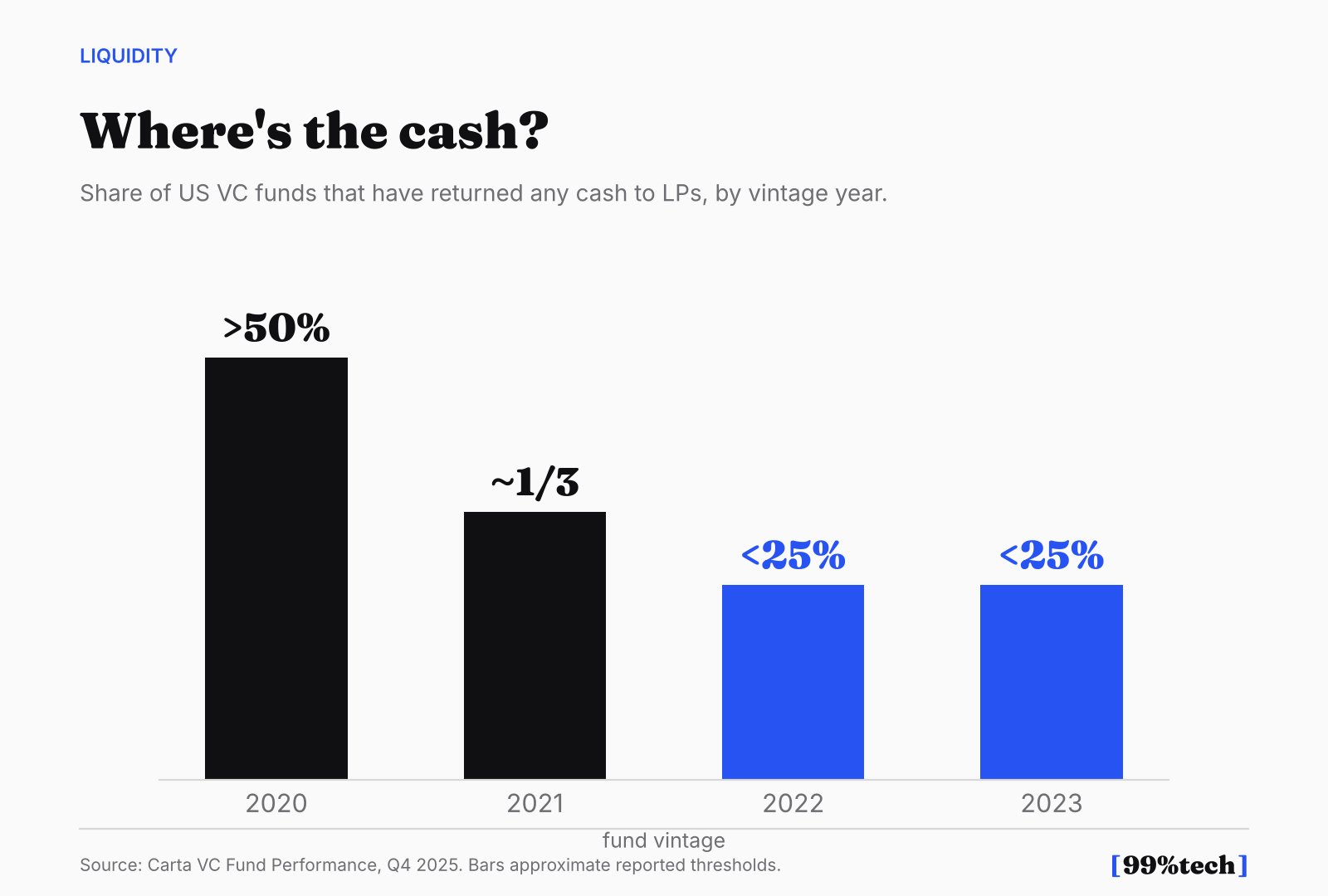
On the exits panel that morning, one manager said roughly 90% of his fund’s exits came through M&A. Another described returning an entire fund through a partial secondary sale while keeping more than half the position. LPs are paying attention. “I do think that in some cases you see these guys wanting a shorter period of returns and quicker DPI,” Alexandre said.
I would add one caution: exits are a lagging indicator. Today’s exit data describes companies built a decade ago, with a decade-old playbook. The more useful question is what kinds of companies are being built now, and whether our products fit them.
4. The companies are changing
AI is changing what gets built, how efficiently it gets built and how fast it goes global.
In Out-Innovate, I wrote about camels: startups built for resilience and capital efficiency, as opposed to unicorns fueled by growth at all costs. For years, camels were the exception founders outside Silicon Valley were forced into. AI is making them the default. A small team can now build what once took 50 engineers. More companies will raise one round, reach profitability, and never need the next mega-round.
That has two consequences. First, as I said on stage, “we might actually see more colors in the rainbow of the types of businesses as well.” A company that raises once and compounds needs a very different partner than one that raises six times. Second, proven models travel faster. When the cost of building drops and the playbook is known, a strong local founder can adapt a model that worked elsewhere in months. That is the core of repeat alpha, and AI is accelerating it. It is the pattern behind companies I have been fortunate to back, like Neon in Brazil, and I think the next wave will scale faster on less capital.
It also changes how quickly companies cross borders. The world AI is building is more global by default, which makes cross-border investors more relevant.
5. Revisit your assumptions
We closed the panel with a lightning round: something you wish you had known when you started.
Alexandre: “I wish I knew the true impacts of AI when we launched Across.” Alfia wished she had known that transforming an industry also means creating new jobs: “What accountants did five years ago is fundamentally different from what accountants do today in our business.”
My own answer: the things that seemed hard turned out not to be the hard things, and the assumptions I thought would be easy, like exits, ended up being the difficult ones.
Every playbook in this industry was written for a world of expensive software, local capital and slow distribution. That world is gone. The investors who do well over the next five years will be the ones willing to rewrite their assumptions before the market forces them to.
What comes next
Earlier that day, Chile’s government laid out plans for a fund-of-funds that would turn the state into a long-term LP in local venture. It is a reminder that the capital stack itself is being rebuilt alongside the tools.
Even venture’s leaderboard is following the money around the world. Roughly 30% of investors on the 2024 Forbes Midas List were based outside the US, and Brazil’s Nubank alone put six investors on it.
My bet is that the winners will look like the specialists on that barbell. They will know something specific: a geography, a sector, a model. They will use AI to ask better questions. And they will remember that every check is a trust transaction. I believe every great founder wants both a global and a local fund on the cap table, and the funds that can be one or the other, with real conviction, will earn that seat.
Alfia closed the panel with a line I keep coming back to: “Quality is fractal. How you do one thing is how you do everything.”
So here is my question for you: if you are building or backing a fund today, which end of the barbell are you on, and what is your specialty?
The camel point has a governance consequence I think gets overlooked. When a company raises once and never needs the next round, the documents from that single round stop being temporary. There is no Series B to reopen the consent rights, board composition or liquidation preference. Should founders taking one cheque now negotiate those terms as if they will live with them for a decade?