![[99%tech]](https://substackcdn.com/image/fetch/$s_!vl72!,w_120,h_120,c_fill,f_webp,q_auto:good,fl_progressive:steep/https%3A%2F%2Fsubstack-post-media.s3.amazonaws.com%2Fpublic%2Fimages%2Fcae24093-688e-4321-a6fa-ee9385f8979c_1024x1024.png)
![[99%tech]](https://substackcdn.com/image/fetch/$s_!Sljl!,e_trim:10:white/e_trim:10:transparent/h_72,c_limit,f_auto,q_auto:good,fl_progressive:steep/https%3A%2F%2Fsubstack-post-media.s3.amazonaws.com%2Fpublic%2Fimages%2F02f85460-45dd-47b2-a64c-f9e2bf0372af_1500x1000.png)

Forward by Alex: It used to be that the best ideas came from Silicon Valley and were replicated around the world. But today, there are over 260 cities that have created a unicorn. Many markets have scaling startup ecosystems. Increasingly, the best founders are building specialized solutions for their local context that turn out to have global relevance. Idea exchange is no longer uni-directional. Models are being replicated from South-to-South.
One category where this is playing out in real time is climate finance. Climate shocks hit frontier markets harder, more frequently, and with less institutional backstop. That combination of acute need and thin legacy infrastructure is exactly the environment where new financial products get invented. We have seen this pattern before: mobile money didn’t start in New York. Parametric insurance at scale didn’t start in London. The next generation of climate financial products is following the same playbook.
This week’s guest post is from David del Ser, founder of Atram, who makes the case that a new category he calls “Extreme Weather Finance” is emerging at the intersection of AI forecasting, stablecoins, and fintech rails. David del Ser has been a longtime friend and collaborator on emerging markets tech. He was one of the leaders of BFA, an investor collaborator at Catalyst Fund (where I was once upon a time an investment committee member) and now an entrepreneur in the category. I’m excited to have him join us on 99%Tech this week.
Guest Post by David del Ser, Founder & CEO of Atram
In September 2024, an AI climate disaster model detected that areas of Kogi State, Nigeria, were about to experience catastrophic flooding. Within 48 hours, over 3,250 households received $105 in digital cash transfers. This was not emergency relief after the disaster; it came nearly a week before the floodwaters arrived, and helped families evacuate, protect assets, and rebuild.
The collaboration between GiveDirectly and Google Flood Hub centred on using AI-powered forecasts to trigger pre-disaster financial support. It showed that a financial instrument delivered digitally and rapidly, ahead of a disaster and personalized to the village level, could have a profound impact on livelihoods. For the households in Kogi State that received a transfer, incomes in the weeks after were more than double compared to control groups without support.
A new category is forming around this shift. Call it Extreme Weather Finance.
The old model is broken
Extreme Weather Finance emerges from the failure of the old system to protect the 200 million people who face climate shocks every year. Three forces have combined to cause this failure:
1. Climate disasters are escalating beyond anything our systems were designed for. As climate change intensifies, natural disasters have caused global economic losses exceeding $300 billion in nine out of the past 10 years. Emerging markets have borne the brunt of this damage due to higher vulnerability and lower preparedness and resilience.
2. The humanitarian safety net is being dismantled. Last year saw a 36 percent fall in international humanitarian assistance, to roughly $15 billion: the largest single-year drop ever recorded. It was owed largely to the elimination of USAID. This is not a temporary dip: the political dynamics driving these cuts are structural.
3. The commercial financial providers who could be filling the gap are instead retreating. CGAP’s 2024 survey of Pakistan’s microfinance sector found that 47 percent of institutions had reduced lending in climate-affected areas, and 20 percent had stopped lending entirely. Pakistan is emblematic of how the very institutions meant to serve vulnerable communities are pulling back precisely when those communities need them most.
For millions of small businesses and people, extreme weather shocks are now part of life: seasonal, recurrent, and deeply disruptive. These shocks are in turn transmitted to the financial system as a growing cost of doing business, one that is currently not accounted for or managed.
The era of Extreme Weather Finance starts in emerging markets
A full-scale transformation is required. The new model will look nothing like the old one.
Just as fintech redefined finance around access and convenience over the past 15 years, Extreme Weather Finance redefines it around resilience: the ability to prepare for, survive, and bounce back from climate shocks. This focus on shock resilience is a core pillar of the broader adaptation finance challenge, working hand-in-hand with long-term risk reduction investments.
Extreme Weather Finance is not traditional insurance, which is too slow, too rigid, and too expensive for these markets. It is not humanitarian aid, which is mostly reactive donations. And it is not conventional lending, which is retreating from the very risks it needs to serve.
What we envision is a new category of commercial, scalable financial products designed for a world where extreme weather events are the norm, not the exception. As well as being rapid and adaptive, as any good fintech product would be, Extreme Weather Finance has four characteristics that set it apart from everything else today:
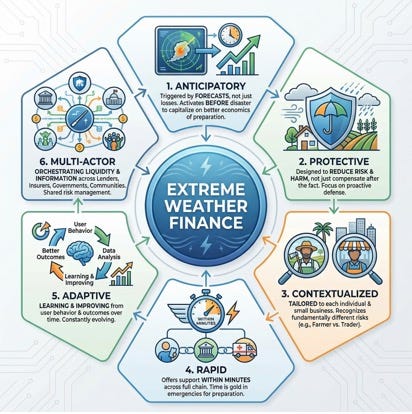
It is anticipatory – triggered by forecasts, not just losses. Products activate before disaster strikes, because the economics of preparation are radically better than the economics of recovery.
It is protective – designed to reduce risk and harm, not just compensate after the fact.
It is contextualized – tailored to each individual and small business, because a farmer in Kogi State faces fundamentally different risks than a market trader in Bogotá.
And it is multi-actor – orchestrating liquidity and information across lenders, insurers, governments and communities, because no player can manage these risks alone.
These characteristics translate into concrete products for every stage of the client’s disaster mitigation efforts. Before the shock: pre-disaster liquidity linked to weather forecasts, incentives for taking protective actions, savings products tied to crisis readiness. During the shock (the first 72 golden hours when the worst choices can still be prevented), emergency loans to stop the negative coping cascade – for instance, fire-sales of productive assets, children pulled from school, meals skipped, high-cost informal debt, each of which is a one-way ratchet that outlasts the flood itself. After the shock: recovery capital, inventory replacement lines backed by supply chain partners, and parametric insurance with fast automated payouts.
Why will this category be built in emerging markets first? Because that’s where the need is most acute, where the protection gap is widest, and crucially, where the fintech rails already reach the last mile. The next great fintech category will come from those places where climate risk is already a daily business reality.
Three technology waves making this possible now
This category is newly buildable thanks to fast-moving technology shifts.
1. AI-powered weather forecasting has reached a tipping point. The ability to predict extreme weather at granular, village-level precision has improved dramatically. AI flood models can now deliver five-to-seven-day advance warnings precise enough to trigger financial transactions, thereby transforming weather data into a financial infrastructure layer. This is the trigger mechanism for an entire class of anticipatory products.
2. Large language models have collapsed the cost of personalized crisis guidance to near zero. People experiencing an extreme weather event need personalized guidance. AI agents can guide millions of users through tailor-made preparation checklists, asset protection strategies, and step-by-step recovery plans. Every extreme weather event becomes a moment where an AI agent can add enormous value and gain a customer’s loyalty.
3. Stablecoins enable trustworthy coordination and blending. Rapid coordination during global crises has long been bottlenecked by slow and expensive cross-border payment rails. Stablecoins not only make transactions faster and cheaper, but enable automatic triggering by climate signals while facilitating trustworthy collaboration between different actors. As an example, Yellow Card is the largest licensed stablecoin platform in Africa and already settles Circle’s USDC payments via Stellar across 20 countries in under three seconds.
The evidence is already here
It’s still early days but the shift from reactive to anticipatory climate finance has already demonstrated compelling results. Following El Niño-induced floods in Malawi, Kenya and Zambia in 2024, VisionFund disbursed fast, flexible and affordable recovery loans to disaster-hit communities – the same communities that microfinance institutions would normally retreat from. Recipients were able to avoid selling assets or closing their businesses; moreover, repayment rates on the loans were 97 percent, enabling the MFI to actually grow their portfolio and market share.
This shift is no longer theoretical; rather, it is measurable, as the outcome of VisionFund’s project shows; it is growing, with anticipatory action scaling from pilot programs to operational frameworks in 47 countries; and it is demonstrating compelling economics: every dollar invested in anticipatory action saves approximately $7 in post-disaster recovery costs.
The broader shift is already visible in the market. Pula, a Kenyan insurtech, has brought parametric crop insurance to 9.6 million smallholder farmers across 22 countries, raising a $20 million Series B led by the Gates Foundation in 2024. Komunidad in Southeast Asia is building an AI-powered climate risk intelligence layer for the banking sector. And capital is following: funding for adaptation equity jumped 64 percent in 2025 to $8.6 billion, the fastest-growing segment in climate tech — a signal echoed by Catalyst Fund‘s pivot from inclusive fintech to a $40 million vehicle for climate adaptation startups in Africa.
And it’s critical that capital flows to this category. Ninety-eight percent of citizens (or 1.5 billion people) in the V20 group of climate-vulnerable nations still lack any financial protection from climate shocks. Microinsurance reaches just 3 percent of vulnerable populations in Sub-Saharan Africa. Sixty percent of banks in emerging markets have less than 5 percent of their portfolios in climate-related lending, and over a quarter offer no climate financing at all.
The gap between what exists and what is needed defines the market opportunity.
It will take a village
The needs are so great that no single company, product, or investor will meet them. Extreme Weather Finance will only reach the scale required if it becomes a category, a shared frame that builders, funders, and institutions work within.
At Atram, we are building some pieces of this puzzle: anticipatory credit lines, climate risk management tools, and AI-powered preparation, working with financial service providers in markets where these needs are most acute.
But in order for this to become a category rather than one company’s success, it needs wide buy-in. If you are building in this space, investing in it, or running a financial institution confronting these risks, we want to hear from you. This will take a village.
David del Ser is the founder and CEO of Atram, a climate fintech building an Extreme Weather Finance platform for emerging markets. Reach him at david@atram.ai.