![[99%tech]](https://substackcdn.com/image/fetch/$s_!vl72!,w_120,h_120,c_fill,f_webp,q_auto:good,fl_progressive:steep/https%3A%2F%2Fsubstack-post-media.s3.amazonaws.com%2Fpublic%2Fimages%2Fcae24093-688e-4321-a6fa-ee9385f8979c_1024x1024.png)
![[99%tech]](https://substackcdn.com/image/fetch/$s_!Sljl!,e_trim:10:white/e_trim:10:transparent/h_72,c_limit,f_auto,q_auto:good,fl_progressive:steep/https%3A%2F%2Fsubstack-post-media.s3.amazonaws.com%2Fpublic%2Fimages%2F02f85460-45dd-47b2-a64c-f9e2bf0372af_1500x1000.png)

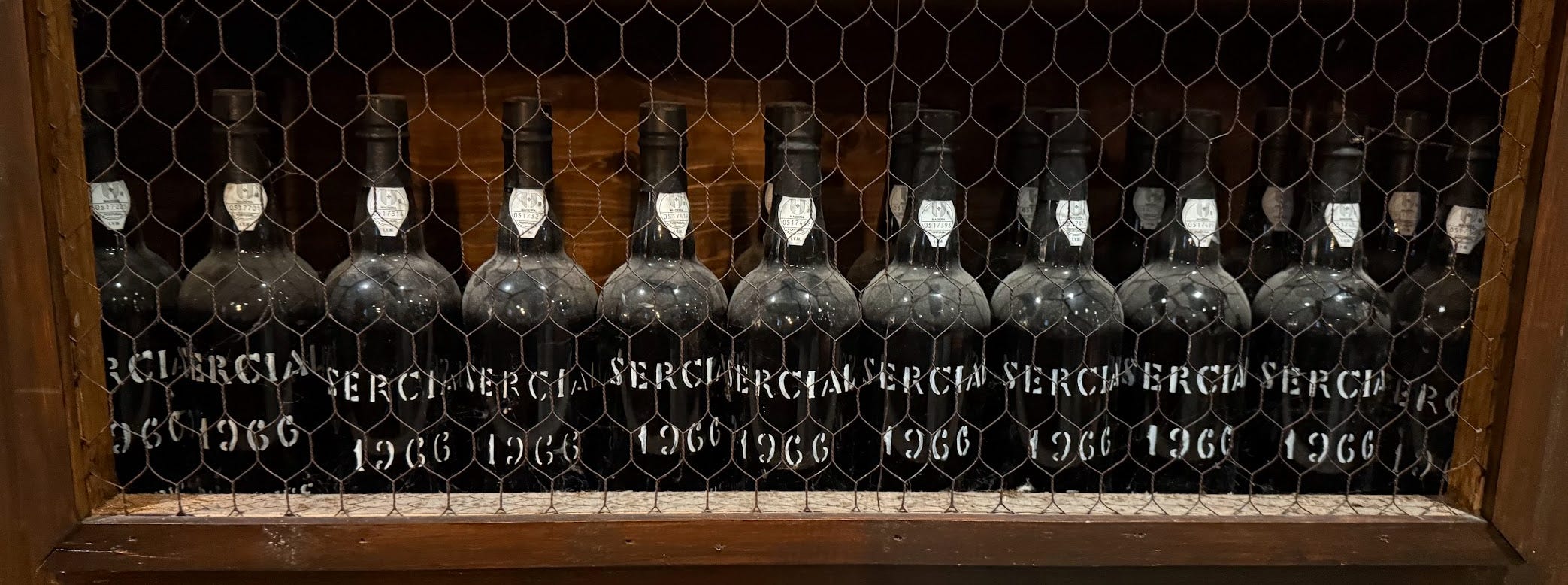
Everything the people of Madeira do to their wine is something a winemaker anywhere else would be fired for. They heat it until it cooks, they leave it open to the air, and for the better part of two centuries they loaded it onto ships and sent it across the equator and back on purpose, because the abuse made it taste better.
I learned all of this the slow way, on a bicycle.
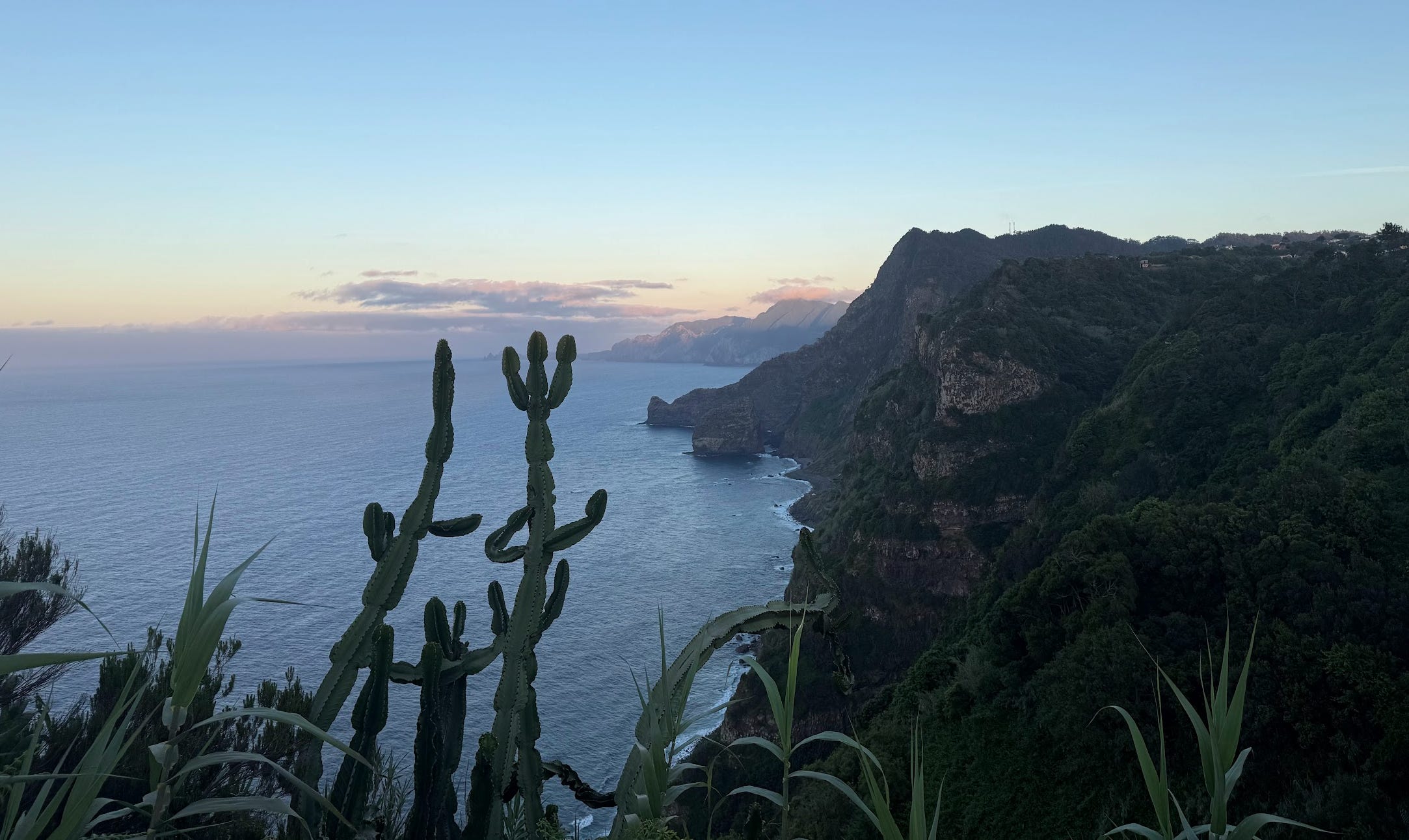
Madeira is one of the only places on earth that makes what the trade calls mountain wine. There is almost no flat ground. The slopes are so steep that the vines have to be planted on hand-built basalt platforms called poios, and a tractor is useless on most of them, so the work is still done by hand on a few hundred hectares of rock in the middle of the Atlantic. I spent the week climbing past those terraces, and somewhere around the third long ascent I stopped thinking about my legs and started thinking about how a place this hostile to agriculture ended up making a wine that outlives the people who make it.
The answer starts with an accident. In the seventeenth century the island was a standard stop for ships heading to the Indies and the Americas, and its wine went into the hold as cargo. The wine that came back from a long round trip, having baked in the tropical heat and rolled in the hold for months, tasted better than the wine that had stayed home. Producers gave the returned barrels a name, vinho da roda, the wine of the round voyage, and for a time they deliberately sent wine out on long ocean trips and back simply to produce the effect. Eventually they worked out how to fake the sea on land. Cheaper wines now go through estufagem, heated to between 45 and 50 degrees Celsius for at least ninety days under the rules of the island’s wine institute. The best wines skip the machinery entirely and spend years, sometimes decades, in casks under the hot eaves of the lodges in Funchal, a slow method called canteiro that accounts for only a sliver of what the island produces.
Here is what all that cooking buys them. A bottle of good Madeira is close to indestructible. Effectively pasteurized, it can age for a century or more, and once you open it you can re-cork it and come back months later to find it intact. The heat and oxidation that would be a death sentence for a Burgundy is the very thing that makes Madeira almost impossible to kill.
I think about resilience this way more and more. In venture we tend to treat durability as the thing you fall back on when growth disappoints, a defensive crouch for hard times.
Madeira makes the opposite case.
Its resilience was not a reaction to a downturn; it was engineered into the product from the start, on purpose, by putting the wine through the worst conditions it would ever face before it ever had to face them. That is the camel, the animal I keep coming back to when I describe the companies I want to back. A camel is not a sickly horse. It is a different animal, built for the desert before the desert arrives, carrying its own reserves, indifferent to the heat that kills everything around it. You do not bolt resilience on when the financing market turns; you build it in while the sun is still out.
The second lesson is about distribution, though the islanders would never have called it that. Madeira was fortified in the first place so it could survive a voyage that destroyed ordinary wine, and that survivability is precisely what let it travel further than its rivals and root itself in distant markets. By the 1700s it was the favorite drink of the American colonies, and roughly a quarter of all of it was shipped across the Atlantic. Centuries later it is still an export product, and its single largest market is the United States, thousands of miles from the rock where the grapes grow. The wine that was built to survive the journey is the wine that took over the destination.
This is the idea I have spent a career chasing. A model built to travel is a model built to diffuse. The products that spread across borders are rarely the cleverest ones; they are the ones whose economics can survive the trip into a market that does not yet want them, that runs on different rules and thinner capital and customers who have never heard of them. Durability is not the opposite of reach. It is the precondition for it.
And now the part I have been turning over since I got off the plane, because it pokes at one of the laziest words in our business. We use copycat as an insult. A founder building a proven model in a new market gets waved away as derivative, a me-too, a clone. Madeira is a quiet rebuke to all of that, because Madeira is itself a copy.
Almost nothing about it is native. The first settlers came from northern Portugal and brought their vines with them. The sweet Malvasia grapes that became the island’s famous Malmsey were carried in from Crete and planted as early as 1450. Sercial, the driest of the noble grapes, is a mainland variety from near Lisbon, where it grows under a different name entirely. The terraces that define the landscape are closely modeled on the ones in the Douro that make port possible. Even the fortification, the single step that made the wine ship well, was borrowed; the islanders did it following the example of port. Strip Madeira down to its parts and it is a collection of plants and techniques lifted from people who had already proven them, carried out to a volcanic rock and reassembled.
So why is it not simply a worse port? Why did the copy become a category with no real substitute anywhere in the world, a wine the originals cannot touch?
Because the copy landed somewhere the original never had to survive, and the new place forced changes the original never had to make. Port did not have to cross the equator. Douro vines did not have to claw their way out of near-vertical basalt with no room for a machine. The proven recipe was only a starting point; what turned it into something singular was the collision between that recipe and a set of local constraints that bent it into a new shape. The heat of the tropical shipping lanes. The volcanic soil that gives the wine its acidity. The isolation that made every shortcut impossible. The borrowing was the easy part; the adaptation was where the value actually came from.
That is the version of copycat advantage I believe in, and it is worth stating precisely, because the lazy version is genuinely wrong. Copying a model into a new market does not win on its own. A founder who ports a foreign playbook without absorbing the conditions of the new market just builds an inferior clone, the worse port that nobody remembers. The advantage shows up only when three things hold at once: the underlying model genuinely transfers, the new market is meaningfully less contested than the one the original is fighting in, and the local conditions differ enough to force real adaptation rather than cheap imitation. When those line up, the replicator is not running behind the original. It is running a de-risked playbook in emptier territory and compounding local advantages the original can never reach back across the ocean to claim, and the terrace itself becomes the moat.
I find this clarifying as an investor, and a little dangerous, because it cuts against the romance of the wholly original idea.
The most globally durable products are often recombinations: a proven thing, carried somewhere new, reshaped by friction it would never have chosen for itself. The friction is not a tax the strategy pays on the way to working; it is the source of whatever ends up being worth copying in the first place.