![[99%tech]](https://substackcdn.com/image/fetch/$s_!vl72!,w_120,h_120,c_fill,f_webp,q_auto:good,fl_progressive:steep/https%3A%2F%2Fsubstack-post-media.s3.amazonaws.com%2Fpublic%2Fimages%2Fcae24093-688e-4321-a6fa-ee9385f8979c_1024x1024.png)
![[99%tech]](https://substackcdn.com/image/fetch/$s_!Sljl!,e_trim:10:white/e_trim:10:transparent/h_72,c_limit,f_auto,q_auto:good,fl_progressive:steep/https%3A%2F%2Fsubstack-post-media.s3.amazonaws.com%2Fpublic%2Fimages%2F02f85460-45dd-47b2-a64c-f9e2bf0372af_1500x1000.png)

This summer, Hims & Hers spent over $1 billion to acquire Eucalyptus, an Australian replicator. Eucalyptus had over 775,000 customers in five countries.
The pattern has a long record. Teladoc paid $352 million for Barcelona-based Advance Medical in 2018. Docplanner, itself a Polish original, bought Doctoralia in Spain and Jameda in Germany. And of course, Hims also bought Honest Health in London in 2021 and Zava across the UK, Germany and France in 2025 before it got to Eucalyptus.
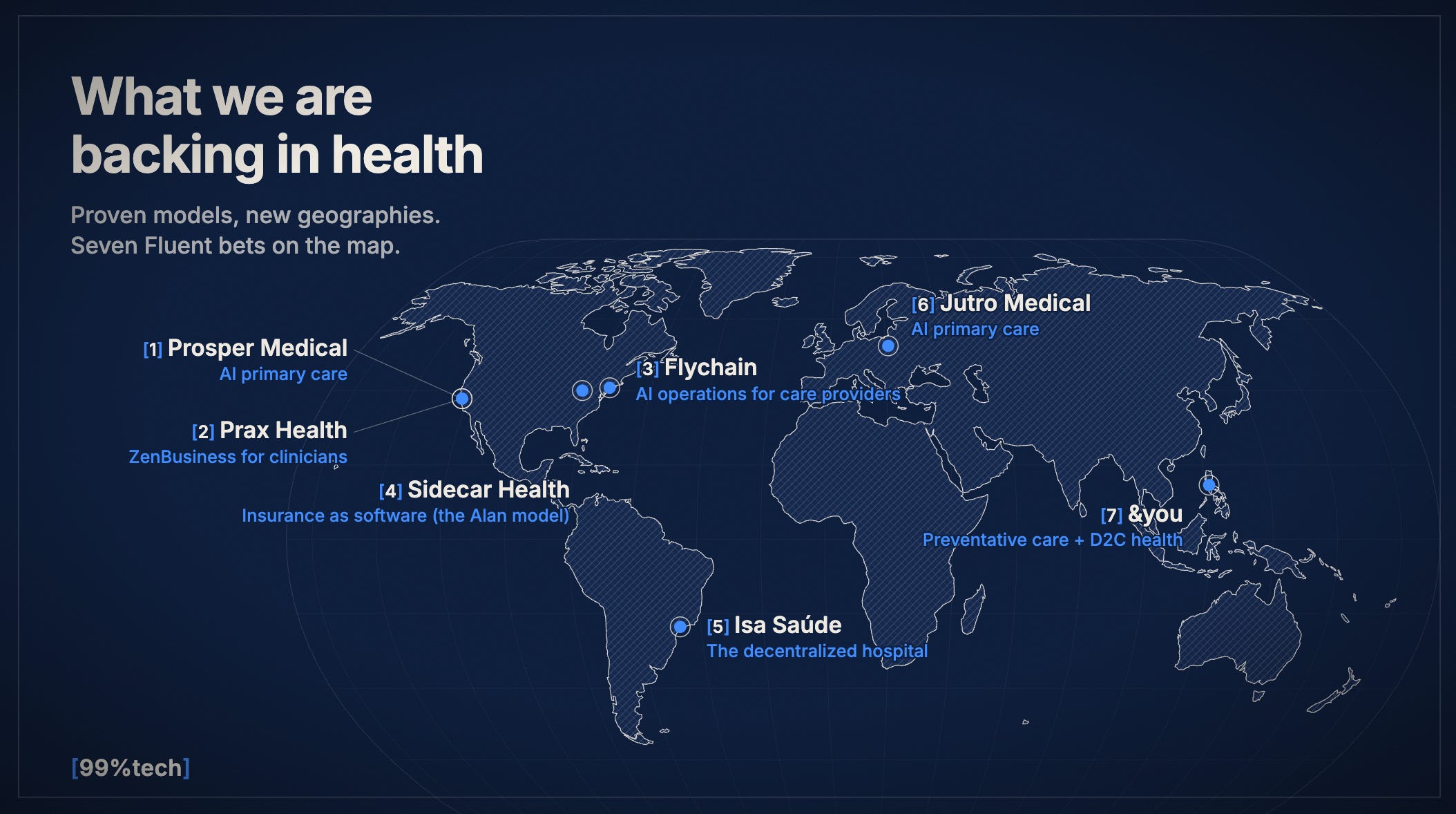
This is Fluent’s strategy. We invest in proven models and apply them in new geographies and new contexts.
Health is one of our three core verticals. We wanted to share a bit about some of the themes we’re exploring.
Fluent target models
When I say “model,” I mean a business model that has worked somewhere, in some industry, and can be moved. Sometimes it crosses a border. Sometimes it crosses an industry.
1. AI primary care
When we say AI primary care, we 1) do not mean telehealth like Teladoc, where you can put a doctor on a video call nor 2) next gen brick-and-mortar plays. The latter has been particularly challenging: Forward shut down in November 2024 after raising more than $400 million. Babylon collapsed in 2023. Carbon Health, the best-funded of the clinic-first plays, filed for Chapter 11 in February and came out in May under its lender with a smaller footprint. One standout of course was One Medical which sold to Amazon for $3.9 billion, though it was still early in its journey.
We believe AI native primary care is a huge opportunity, combining the two models.
First, AI as a coordination and automation layer powering human touch. This is borrowed from unicorns emerging in accounting, law and customer support.
Prosper Medical is the American one. Ryan McQuaid and Dr. James Wantuck founded PlushCare and sold it to Accolade for about $450 million in 2021. Their second company sells concierge primary care for $69 a month: a dedicated physician, a care team, and in-network insurance coverage. Prosper closed a $16 million seed led by FUSE in July.
—> We wrote about why we invested in Prosper here.
The second is the use of an AI roll-up to support the generational transition in small-business ownership. Jutro Medical is the European investment here. Adam Janczewski is building AI-enabled primary care in Poland, where the state payer and a doctor shortage make the labor math even harsher than in the US. Jutro’s growth motion is an AI roll-up, another growing global strategy in the age of AI: it buys clinics, nine in 2025, and migrates them onto one software and AI platform. We are particularly looking in mid-sized markets where there will not be 10 competitors.
—> We wrote about why we invested in Jutro, and which AI roll-ups actually work, in December.
2. AI for preventative care + D2C Health
A related but different theme is AI in preventative care and direct to customer healthcare.
D2C healthcare model, arguably the most replicated model in health, also has the clearest exit path. Hims & Hers did $2.35 billion in revenue in 2025 on a simple insight: people will seek treatment online for the conditions they will not raise in a waiting room. Hair loss, sexual health, weight. GLP-1s turned that from an occasional purchase into a subscription.
In diagnostics, companies like Function Health (and Superpower etc) sell a membership for biomarkers: comprehensive lab testing, longitudinal tracking, protocols. It raised at $2.5 billion in November and took another $450 million from General Catalyst in July. Neko Health, out of Stockholm, does the same thing with its own scanning hardware and just raised $700 million.
We are seeing these models converge. In the Philippines, for example, &you, founded by Emil Eriksen in Manila, is the regulated answer: licensed Filipino doctors, compliant compounding, discreet delivery within 48 hours. It is a camel - reaching profitability before raising its pre-seed, which Fluent coled with Everywhere Ventures.
—> We wrote about why we invested in &you here.
We believe the convergence between primary care, preventative care and D2C delivery will continue.
3. The decentralized hospital
Brazil has 2.5 hospital beds per 1,000 people, below the WHO’s recommended three. Only about a quarter of Brazilians carry private insurance, and the insurers that cover them run on margins of roughly 1%. Meanwhile, the clinical workforce is large, largely independent and underpaid: only a third of Brazilian physicians hold a formal employment contract, and more than a third of nurses work more than one job.
Isa Saúde is a solution. So far, it delivers up to 70% of hospital services in the patient’s home (more to come) including clinical visits, infusions, chronic disease management and others. The customer is the insurer or employer, who cuts the cost of a hospital-equivalent episode by as much as 90%. The workforce is a distributed network of nurses and therapists, dispatched by software, paid well above market. Think Uber, applied to the hospital. Fluent is an investor. Isa now sees more than 1,500 patients a day across 60 cities and raised a $30 million Series B led by IFC last October.
The travel conditions for this model are specific: a private payer that is losing money, a bed shortage, and a clinical workforce that is large but underpaid.
But the underlying trend of shifting care from inside a centralized hospital to be closer to patient’s home or place of need, is global. In the US models like DispatchHealth and Medically Home grew up under a CMS waiver, extended this year through 2030. Cera in the UK, at three million home visits a month and free-cash-flow positive, is another example.
We expect to see this model proliferate more globally.
4. AI healthcare back-office operations
Here is a model that crossed an industry rather than a border. ZenBusiness and LegalZoom proved that entity formation is a cheap wedge into a long tail of recurring back-office services for small businesses. Shopify showed that powering the whole small business is the larger opportunity.
Yet these are built on standardization and simplicity. This doesn’t translate to the complexities of healthcare incorporations, integrations and unique staffing challenges. So new bespoke models are necessary for healthcare’s massive verticals.
Headway proved this for therapists, and was last valued at $2.3 billion. Prax Health applies it to nurse practitioners and physician assistants, the fastest-growing clinical occupation in the US. Twenty-seven states and DC now let NPs practice independently, and in one 2024 survey a third of NPs said they had opened or planned to open their own practice. Starting one used to mean a specialist attorney and up to $15,000. Prax handles the entity, the collaborating-physician agreement, malpractice insurance, and the billing and banking that follow. Meghan Jewitt, Heather Wake, and Nick Elser have raised nearly $10 million from Floodgate, Canaan, Refract, and Meridian Street. Fluent has been an investor since the first check. We wrote about why here.
We also invested in Flychain, which runs the financial back office for small healthcare practices, from bookkeeping and tax to working capital, starting in home health, ABA therapy and home infusion. We think the Ramp model applies readily to the category.
Lastly, we believe the AI operating system will extend to the hospital. In the US Epic is the core ERP. We are seeing much experimentation around AI ERP systems, or built on top. We think there is an opportunity here as an overlay with optionality on ERP or in markets with slower incumbents to become the ERP.
5. Insurance and health behavior change
Alan in France sells health insurance the way a software company sells software: an app as the front door, employers as the channel, and the care experience as the product. It crossed €800 million in annualized revenue this year and raised at a €5.5 billion valuation in June. Alice and Sami are running versions of it in Brazil.
I supported Sidecar Health before Fluent in the US. Sidecar could not apply Alan’s employer-channel supplementary product, because the US has no national base layer to supplement. So it rebuilt the model around the one thing the US market lacks and Europe does not: price transparency. Sidecar members pay cash prices with a set benefit and no network.
We keep looking at this model because it is where our fintech and health work overlap, and because demographic-specific versions of it (seniors, in particular) are just starting to appear.
While we remain interested here, we are soon sunsetting this theme since we think the early winners have been played already.
Aging: emerging area of interest for new business models
Lastly, we are interested in aging as an upcoming category. There are multiple layers.
The first is long-term care at home: custodial, chronic, paid by families or private insurance, not by a hospital-substitution contract. Isa touches this layer from the acute side, and it is the natural next layer for it to move into, but we do not yet have a bet on custodial care itself.
The second is the senior-care coordination and/or marketplace. In the US Honor has dominated the marketplace space. New models around AI operating systems (that may combine recruitment) are of interest.
The third is the senior payer. Devoted Health is worth about $16 billion in the US, but it exists because Medicare Advantage pays a fixed sum per senior to a private plan, and almost no other country does that. Koltin in Mexico is building senior insurance without that subsidy. We are looking for founders on all three layers as we get smart on these.
A few observations
We believe the addressable market can be larger in an international replica’s market if they become compound startups - combining multiple of the above (or other) trends together. For example, Isa is not a home-care agency. It is a dispatch network, a training academy and a payer-contracting business at once, because none of those existed to plug into. What is a feature in San Francisco is the whole company in São Paulo, and the revenue pool follows.
Often, the value proposition shifts as the model travels. Hims sells speed and discretion. &you sells trust, because the alternative for a Filipino buying a GLP-1 is a Facebook group and an unlabeled vial. Same product, different job.
Where localization matters most is go-to-market. Health is sold to patients, employers, insurers, clinicians or governments depending on the country, and a founder who copies the product without understanding the local buying motion is bound to fail.
Some of this is still moving. Roll-ups, which we treat as a go-to-market motion rather than a model, are showing up inside several of these categories at once, and AI is changing what a small clinic acquisition is worth.
We will be wrong about some of it, but believe many of these will be right.
—> What am I missing? If you are building any of these anywhere, or the model I have not listed, I want to hear from you.